A Spiral Amongst Thousands
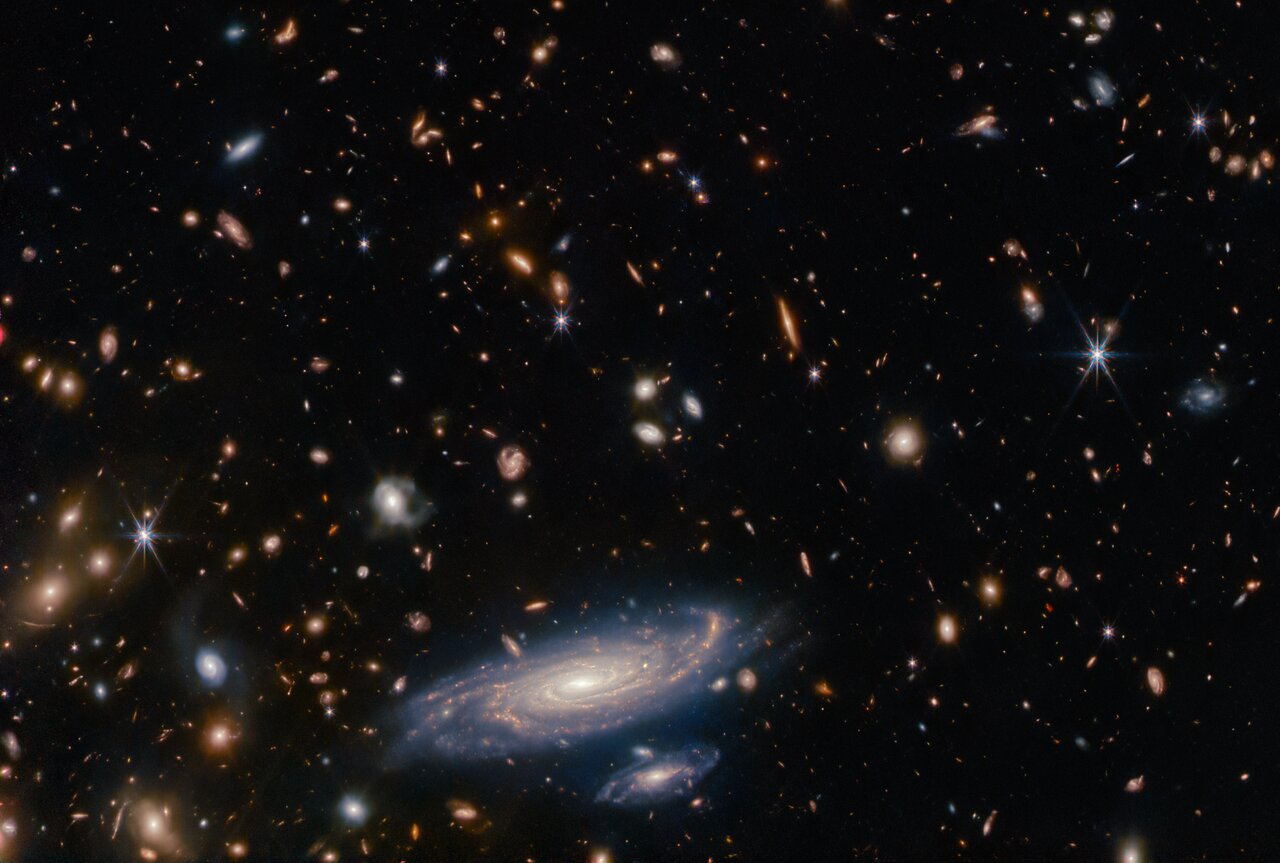
A crowded field of galaxies throngs this ESA/Webb Picture of the Month from the NASA/ESA/CSA James Webb Space Telescope, along with bright stars crowned with Webb’s signature six-pointed diffraction spikes. The large spiral galaxy at the base of this image is accompanied by a profusion of smaller, more distant galaxies which range from fully-fledged spirals to mere bright smudges. Named LEDA 2046648, it is situated a little over a billion light-years from Earth, in the constellation Hercules. One of Webb’s principle science goals is to observe distant galaxies in the early universe to understand the details of their formation, evolution, and composition. Webb’s keen infrared vision helps the telescope peer back in time, as the light from these distant galaxies is redshifted towards infrared wavelengths. Comparing these systems with galaxies in the local Universe will help astronomers understand how galaxies grew to form the structure we see today. Webb will also probe the chemical composition of thousands of galaxies to shed light on how heavy elements were formed and built up as galaxies evolved. To take full advantage of Webb’s potential for galaxy archeology, astronomers and engineers must first calibrate the telescope’s instruments and systems. Each of Webb’s instruments contains a labyrinthine array of mirrors and other optical elements that redirect and focus starlight gathered by Webb’s main mirror. This particular observation was part of the commissioning campaign for Webb’s Near-InfraRed Imager and Slitless Spectrograph (NIRISS). As well as performing science in its own right, NIRISS supports parallel observations with Webb’s Near-InfraRed Camera (NIRCam). NIRCam captured this galaxy-studded image while NIRISS was observing the white dwarf WD1657+343, a well-studied star. This allows astronomers to interpret and compare data from the two different instruments, and to characterise the performance of NIRISS. [I mage description : Many stars and galaxies lie on a dark background, in a variety of colours but mostly shades of orange. Some galaxies are large enough to make out spiral arms. Along the bottom of the frame is a large, detailed spiral galaxy seen at an oblique angle, with another galaxy about one-quarter the size just beneath it. Both have a brightly glowing core, and areas of star formation which light up their spiral arms.]
Hubble Uses Microlensing To Measure the Mass of a White Dwarf
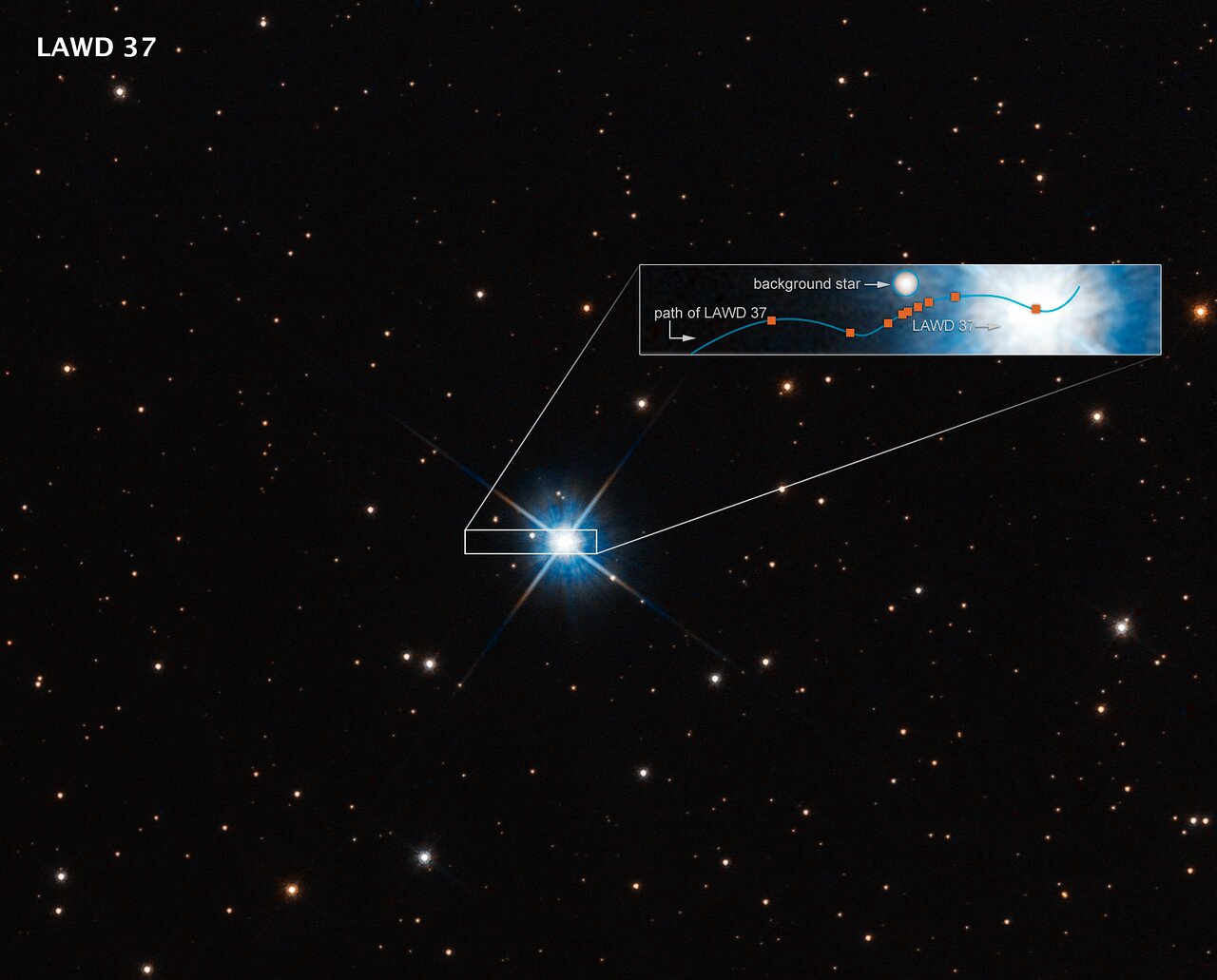
This graphic shows how microlensing was used to measure the mass of a white dwarf star. The dwarf, called LAWD 37, is a burned-out star in the centre of this Hubble Space Telescope image. Though its nuclear fusion furnace has shut down, trapped heat is sizzling on the surface at roughly 100 000 degrees Celsius, causing the stellar remnant to glow fiercely. The inset box plots how the dwarf passed in front of a background star in 2019. The wavy blue line traces the dwarf’s apparent motion across the sky as seen from Earth. Though the dwarf is following a straight trajectory, the motion of Earth as it orbits the Sun imparts an apparent sinusoidal offset due to parallax. (The star is only 15 light-years away. Therefore, it is moving at a faster rate against the stellar background.) As it passed by the fainter background star, the dwarf’s gravitational field warped space (as Einstein’s general theory of relativity predicted a century ago). And this deflection was precisely measured by Hubble’s extraordinary resolution. The amount of deflection yields a mass for the white dwarf of 56 percent our Sun’s mass and provides insights into theories of the structure and composition of white dwarfs. This is the first time astronomers have directly measured the mass of a single, isolated star other than our Sun.
Hubble Measures Deflection of Starlight by a Foreground Object
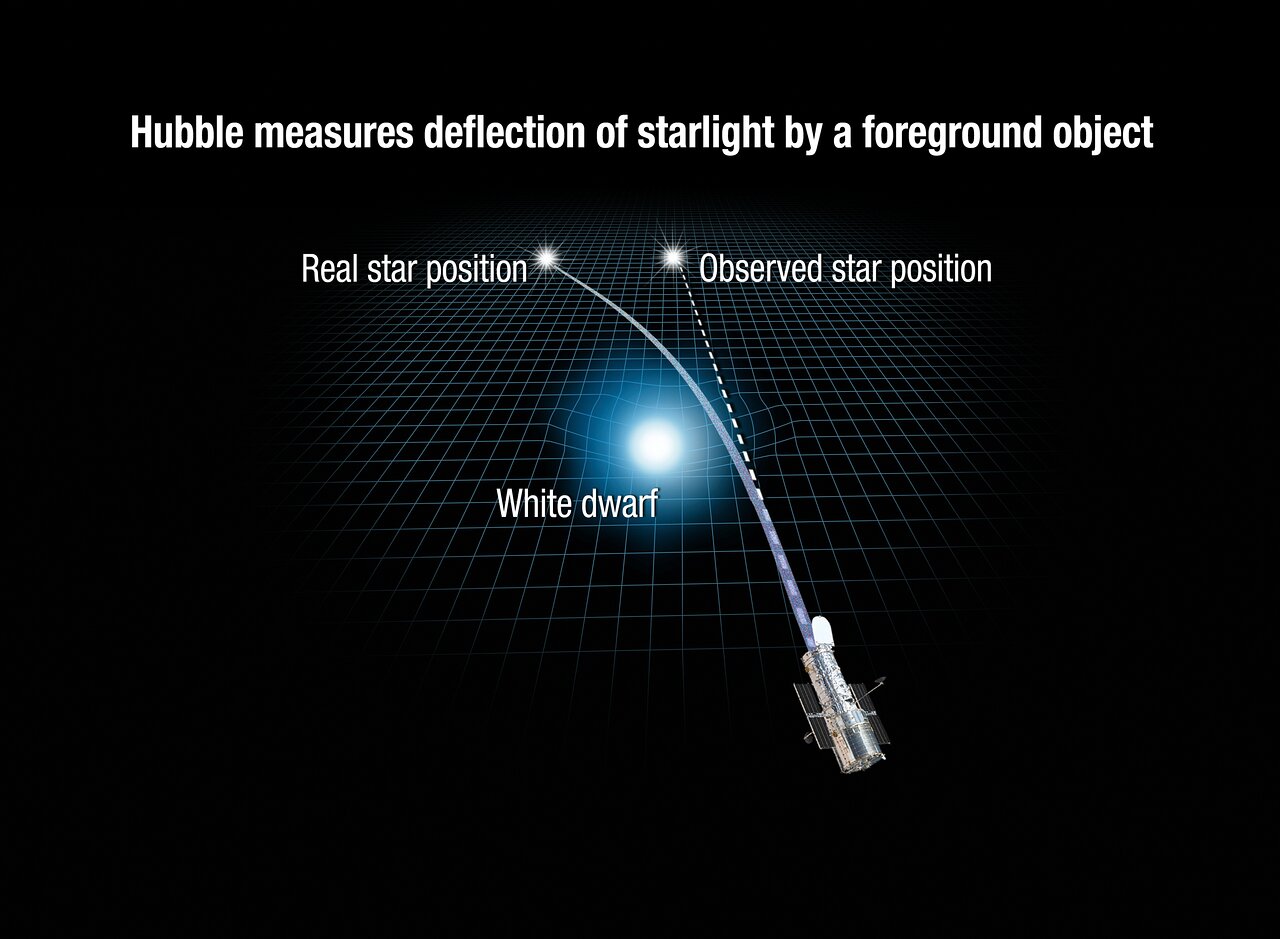
This illustration shows how the gravity of a foreground white dwarf star warps space and bends the light from a distant star behind it. Astronomers using the NASA/ESA Hubble Space Telescope have for the first time directly measured the mass of a single, isolated star other than our Sun — thanks to this optical trick of nature. The target was a white dwarf — the surviving core of a burned-out Sun-like star. The greater the temporary, infinitesimal deflection of the background star’s image, the more massive the foreground star is. Researchers found that the dwarf is 56 percent the mass of our Sun. This effect, called gravitational lensing , was predicted as a consequence of Einstein’s general theory of relativity from a century ago. Observations of a solar eclipse in 1919 provided the first experimental proof for general relativity. But Einstein didn’t think the same experiment could be done for stars beyond our Sun because of the extraordinary precision required.
Hubble Uses Microlensing To Measure the Mass of a White Dwarf (Clean)
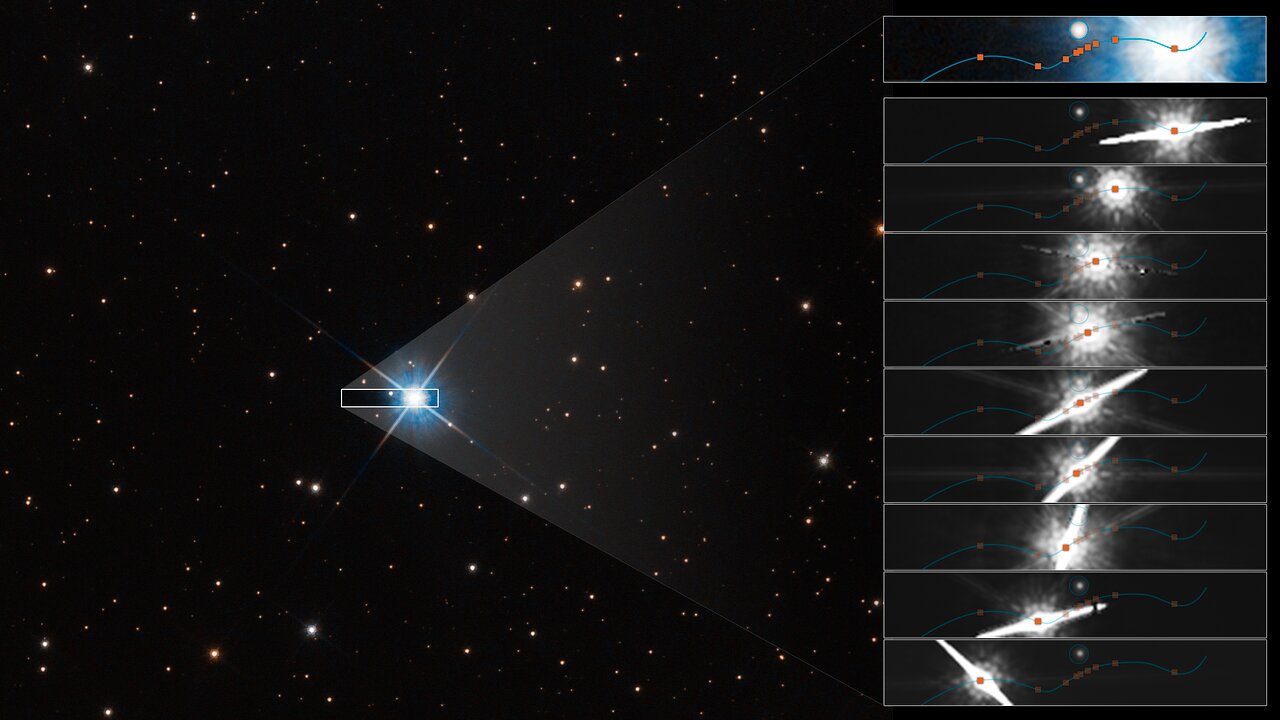
This graphic shows how microlensing was used to measure the mass of a white dwarf star. The dwarf, called LAWD 37, is a burned-out star in the centre of this Hubble Space Telescope image. Though its nuclear fusion furnace has shut down, trapped heat is sizzling on the surface at roughly 100 000 degrees Celsius, causing the stellar remnant to glow fiercely. The inset boxes at right plot how the dwarf passed in front of a background star in 2019. The wavy blue line traces the dwarf’s apparent motion across the sky as seen from Earth. Though the dwarf is following a straight trajectory, the motion of Earth as it orbits the Sun imparts an apparent sinusoidal offset due to parallax. (The star is only 15 light-years away, and therefore is moving at a faster rate against the stellar background.) As it passed by the fainter background star, the dwarf’s gravitational field warped space (as Einstein’s general theory of relativity predicted a century ago). And this deflection was precisely measured by Hubble’s extraordinary resolution. The dwarf’s offset position is coloured orange. The amount of deflection yields a mass for the white dwarf of 56 percent our Sun’s mass, and this provides insights into theories of the structure and composition of white dwarfs. This is the first time that astronomers have directly measured the mass of a single, isolated star other than our Sun. The white dwarf has a ‘spike’ because it is so bright that the light ‘bled’ into the Hubble camera’s CCD detector. This interfered with one of the observing dates for measuring that background star’s position on the sky.